No products added!
Ayurvedic Wisdom
Ayurveda is regarded as one of the most ancient systems of knowledge in the world. It is not merely a system of medicine, but a comprehensive science concerned with the understanding of life in its entirety – encompassing the body, the mind, the senses, and their continuous interaction with nature.
Derived from two Sanskrit words — Ayu, meaning life, and Veda, meaning knowledge or science — Ayurveda is understood as the science of life. A system devoted to the preservation of balance, the sustenance of vitality, and the prevention of disorder before it manifests.
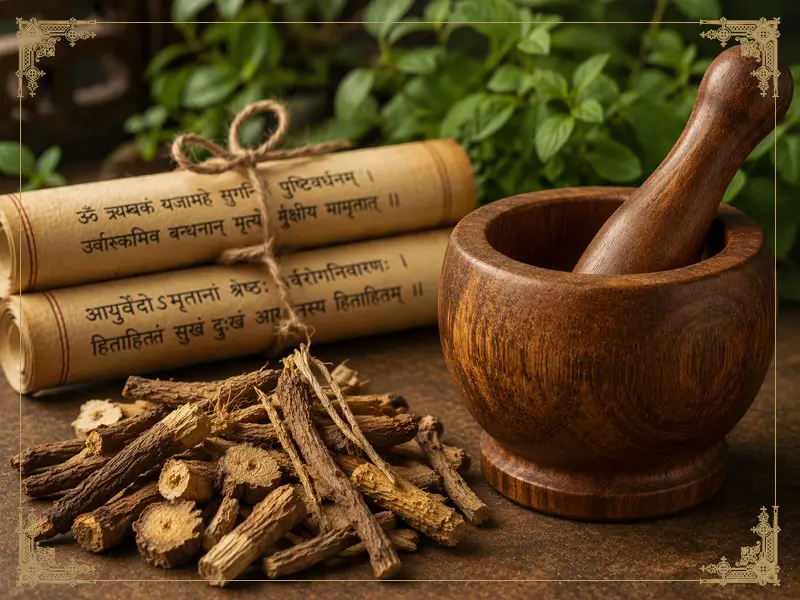
Its philosophical foundations are found within the four Vedas — the Rigveda, Yajurveda, Samaveda, and Atharvaveda. Among these, the Atharvaveda is regarded as the primary source where early concepts of healing, herbs, and the understanding of bodily processes first emerged.
Over centuries, this knowledge was compiled and systematised into the classical Ayurvedic texts that continue to guide practice today:
- Charaka Samhita — focusing on internal medicine and the principles of health.
- Sushruta Samhita — known for its detailed descriptions of anatomy, skin, and surgical knowledge.
- Ashtanga Hridaya — presenting a comprehensive synthesis of Ayurvedic knowledge.
- Bhaishajya Ratnavali — a classical compendium of therapeutic formulations.
These texts describe not only the management of disease, but the preservation of health, longevity, and natural beauty through balanced living and the wisdom of herbs.
The Ayurvedic Definition of Health
Ayurveda does not define health as the absence of disease. It defines it as a state of dynamic equilibrium — articulated in the classical definition of Swastha from the Sushruta Samhita:
समदोषः समाग्निश्च समधात मलक्रि यः ।
प्रसन्नात्मन्द्रियमनः स्वस्थ इत्यभिधीयत ॥
Samadoṣaḥ samāgniśca samadhātu malakriyaḥ
Prasannātmendriya manaḥ svastha ityabhidhīyate.
A person is considered healthy when the Doshas — Vata, Pitta, and Kapha — Agni, the Dhatus, and the Malas are in equilibrium, and when the mind, senses, and soul exist in a state of contentment. Wellbeing, in this understanding, is not partial. It is integrative — extending across every level of existence.
Ayurveda also emphasises the preservation of health through the guiding principle described in the Charaka Samhita:
स्वस्थस्य स्वास्थ्य रक्षणंआतरस्य विकार प्रशमनंच।
Swasthasya Swasthya Rakshanam, Aturasya Vikara Prashamanam.
The purpose of Ayurveda is to protect the health of the healthy and to alleviate imbalance where it has arisen. This establishes Ayurveda not only as a system of treatment, but as a discipline of prevention and sustained harmony.

The Tridosha
Central to this system is the theory of the Tridosha — Vata, Pitta, and Kapha — the fundamental regulatory principles governing all physiological activity.
Vata, composed of air and ether, governs movement, circulation, and communication within the body. Pitta, associated with fire and water, governs transformation, metabolism, and biochemical processes. Kapha, derived from earth and water, governs structure, cohesion, and stability.
The balance of these three forces determines the state of health. Their disturbance leads to the manifestation of imbalance.
Understanding the Skin — Sapta Twak
In Ayurveda, the skin — Twak — is not regarded as a superficial covering. It is a complex, multi-layered organ described in the Sushruta Samhita as Sapta Twak — seven distinct layers, each responsible for specific physiological functions.
- Avabhasini — the outermost layer, responsible for complexion and visible radiance.
- Lohita — associated with circulation and pigmentation.
- Shweta — linked with structural clarity and balance.
- Tamra — supports skin metabolism and transformation.
- Vedini — the sensory layer responsible for perception.
- Rohini — involved in healing and regeneration.
- Mamsadhara — the deepest layer, providing structural support.
The condition of the skin is understood as an external reflection of internal processes — shaped by the state of the Doshas, the quality of nourishment, and the integrity of bodily systems.
Rasa Dhatu and the Nourishment of Skin
Ayurveda identifies the nourishment of the skin with the proper formation of Rasa Dhatu — the primary nutritive tissue responsible for sustaining all other tissues within the body. Rasa serves as the initial medium through which nutrients are distributed, and its quality directly influences the vitality, clarity, and resilience of the skin.
When Rasa is balanced and well-formed, the skin reflects luminosity and health. When it is disturbed, this is expressed through dullness, dryness, or imbalance.
The Intelligence of Herbs in Ayurveda
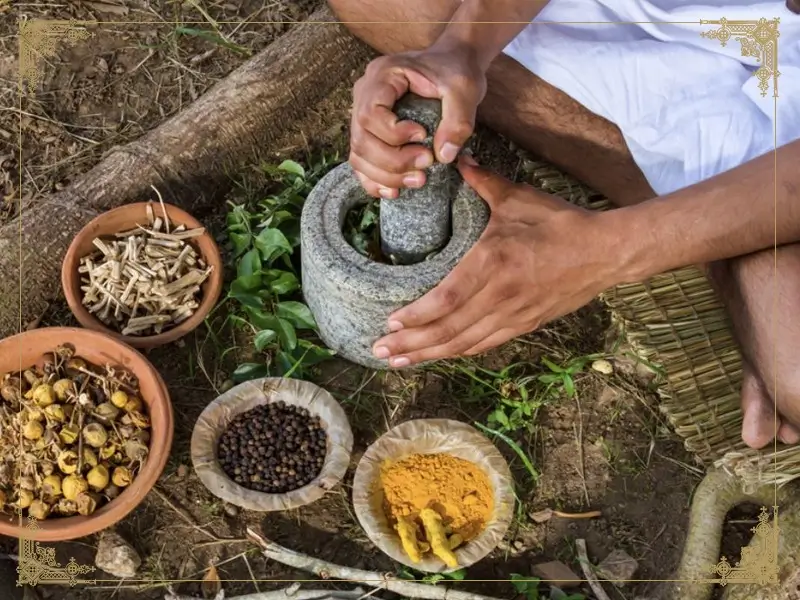
Ayurveda provides a profound and systematic understanding of plants. Every herb is evaluated through its pharmacological attributes:
- Rasa — the immediate sensory property influencing the body.
- Guna — inherent physical characteristics such as lightness, smoothness, or unctuousness.
- Virya — the energetic effect, either heating or cooling.
- Vipaka — the long-term metabolic influence.
- Prabhava — the unique therapeutic effect of the herb.
Through this multidimensional approach, Ayurveda identifies ingredients that support the nourishment, clarity, and vitality of the skin.
Varnya Mahakashaya - Herbs that Support Natural Complexion
Ayurveda describes a special group of herbs known as Varnya Mahakashaya in the Shadvirechana Shatashritiya Adhyaya of Charaka Samhita. These herbs are traditionally valued for supporting natural complexion, clarity, and healthy skin.
The beauty of the skin, classical Ayurvedic descriptions explain, is expressed through two qualities — Chaya and Prabha. Chaya refers to the natural complexion visible when observed closely. Prabha denotes the radiance or glow that becomes noticeable even from a distance. Together they reflect the vitality and balance of healthy skin.
The ten herbs traditionally described in the Varnya Mahakashaya group are:
- Chandana (Santalum album) — Rasa: Tikta, Madhura. Virya: Shita. Traditionally valued for its cooling and soothing influence on the skin.
- Padmaka (Prunus cerasoides) — Rasa: Tikta, Kashaya. Virya: Shita. Traditionally described as supporting clarity and brightness of complexion.
- Nagakeshara (Mesua ferrea) — Rasa: Tikta, Kashaya. Virya: Mild Ushna. Traditionally valued for supporting balanced skin tone and texture.
- Ushira (Vetiveria zizanioides) — Rasa: Tikta, Madhura. Virya: Shita. Known for its cooling and calming influence on the skin.
- Manjistha (Rubia cordifolia) — Rasa: Tikta, Kashaya, Madhura. Virya: Ushna. Traditionally described as Rakta-prasadaka, supporting clarity of complexion.
- Sariva (Hemidesmus indicus) — Rasa: Madhura, Tikta. Virya: Shita. Traditionally used for nourishing and balancing skin tissues.
- Shweta Durva (Cynodon dactylon) — Rasa: Tikta, Kashaya. Virya: Shita. Traditionally known for its cooling and soothing effect on the skin.
- Harita Durva (Cynodon dactylon – green variety) — Rasa: Tikta, Kashaya, Madhura. Virya: Shita. Traditionally used to support skin balance and clarity.
- Yashtimadhu (Glycyrrhiza glabra) — Rasa: Madhura. Virya: Shita. Traditionally valued for nourishing and soothing skin health.
- Kshiravidari (Ipomoea digitata) — Rasa: Madhura. Virya: Shita. Traditionally described as nourishing and supporting tissue vitality.
These herbs are traditionally described as Varnya, Rakta-prasadaka, and Pitta-shamaka – helping maintain the natural clarity and radiance of the skin.
Within this holistic understanding, beauty is not an isolated or cosmetic attribute. It is a natural outcome — arising from balance, nourishment, and harmony within the body. Radiance is not created through external intervention. It is revealed when the internal equilibrium of the system is maintained.
This is the essence of Ayurvedic wisdom — a system that does not impose upon the body, but seeks to understand it, support it, and restore it to its natural state of balance.